
Georgetown Arts & Cultural Center is pleased to present In Bloom, a group exhibition on view May 16 through June 13, 2026, featuring work by Mary Bailey, Hannah Barrett, Diana Gubbay, Heide Follin, Eric Hibit, Catherine Howe, Erin Kono, Ann McRae, Mary Newhouse, Maggie Nowinski, Lawre Stone, and Lydia Viscardi.
A plant is never just a plant. It carries medicine and poison, memory and loss, the domestic and the wild, the carefully tended and the out of control. Across painting, sculpture, drawing, digital media, and collage, the twelve artists in In Bloom engage with botanical form as a carrier of human history: the poppy that heals and destroys, the invasive species that colonizes without announcement, the garden flower pressed into allegory, the domestic textile worked by hands we will never know. What connects them is an interest in what lies beneath — beneath the surface of the paint, beneath the beauty of the bloom, beneath the familiar form of a flower — and a shared attention to the full organism, its hidden systems as present and as consequential as what is visible above ground.
Mary Bailey carves basswood into botanical forms that have never existed in nature. The wood is left unpainted, pale and warm, and the forms arrive at their meaning through shape alone. Hannah Barrett paints flowers with dark outlines, flattened space, and the close attention of someone who has studied Medieval illumination. Her paintings look like gardens and feel like moral tales — the flowers, the vessel, the toad at the lower right all carry the weight of Medieval allegory, where nothing is merely what it appears to be. Heide Follin builds her paintings in layers, staining and pouring and collaging over printed fabric until botanical structures emerge - revealing and obfuscating the textile.
Eric Hibit draws inspiration from his backyard garden in Queens, NY. In his painting, he simplifies dahlia, snapdragon, and zinnia down to their chromatic and structural essences, and sets them in his hand-built ceramic vase whose handles simultaneously evoke the Greek key motif and the strong-arm emoji. Erin Kono works in egg tempera on shaped wood icon panels, drawing on pre-Renaissance techniques and cross-cultural heritage. Her poppies overflow ceremonial bowls decorated with watchful faces and coiling serpents. Beauty and the capacity for harm occupy the same stem. Ann McRae builds densely layered watercolors inspired by the Persian miniaturists, where every inch of the surface carries pattern — gold-outlined chambers, spiral shells, stippled grounds, interlocking botanical systems — and every element carries equal weight. Catherine Howe builds her canvases in layers: first a copper-and-mica ground, then splashes of color, then invented flowers that lean and reach with an urgency that has nothing to do with sunlight or soil.
Lawre Stone paints oversized poppies in oil on canvas — flowers that yield crucial pain relief and highly addictive drugs in equal measure. Mary Newhouse (1935–2010) made paintings in which the natural world dissolved into color and feeling, the recognizable just visible beneath layers of abstraction. Lydia Viscardi layers acrylic, collage, and vintage hand-crafted textiles onto shaped panels, building narrative worlds that feel both remembered and invented — dense, seasonal, teeming with life, as if every story the materials have ever held is being told at once. Diana Gubbay's work finds in botanical form a quiet grammar of transformation — her images catch plants mid-reveal, neither fully open nor fully closed. Maggie Nowinski works in obsessive, accumulative pen and ink to construct imagined specimens — plant-animal hybrids that press outward from voids of solid black, adaptation rendered as mark, the hidden systems of living organisms given form through thousands of uninterrupted strokes.
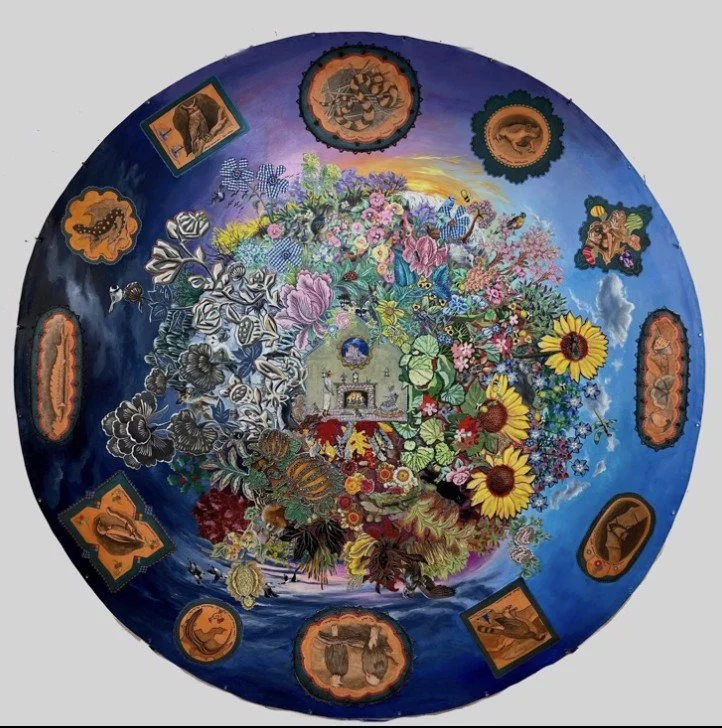
Lydia Viscardi's Museum of Seasons
In Bloom understands that the way a culture treats its plants — which ones it cultivates, which ones it lets die, which ones it allows to take over — is a precise record of its priorities, its failures, and what it still has time to change.
Wilson Avenue Loft Artists Artist Heide Follin invites viewers into a lush and layered world where botanical forms become vessels for memory, emotion, and transformation. Her paintings move between abstraction and organic structure, revealing hidden networks of growth, fragility, and resilience through luminous color and intricate linework. We are thrilled to celebrate Heide’s inclusion in “IN BLOOM” at the Georgetown Arts & Cultural Center in Redding, CT — a group exhibition exploring the deeper meanings carried within botanical imagery. As the exhibition states: “A plant is never just a plant… it carries medicine and poison, memory and loss, the domestic and the wild.” IN BLOOM Georgetown Arts & Cultural Center May 16 – June 13, 2026 Opening Reception: Saturday, May 16, 4–6 PM Congratulations Heide on this beautiful exhibition!